Meme coin trading: how a $450,000 month is built and what it really costs
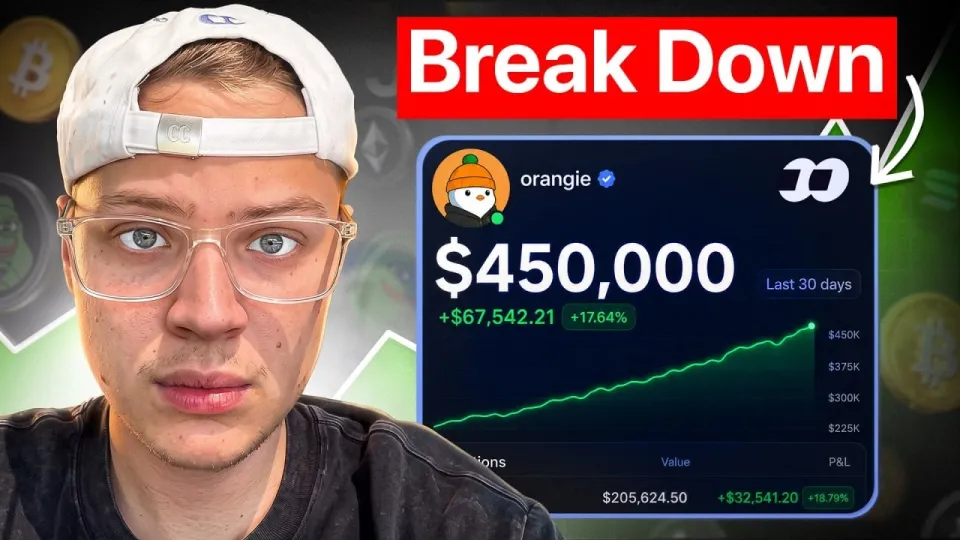
Video: How I Made $450,000 Trading Memecoins in 30 Days
You can order the same kind of articles for your own video to boost it on YouTube and Google. Just message the Telegram bot @sat_sit_bot. The bot writes and publishes the articles itself (with your YouTube video embedded) on popular topical websites (no ads). Try it free: 50 articles on us.
· based on the channel Orangie Web3
Key takeaways
- Orangie Web3 reports turning roughly $450,000 in profit trading memecoins over 30 days in a video published 03.09.2026.
- Most memecoin volume in 2026 runs on Solana launchpads, where a token can go from launch to 'graduation' in minutes.
- The strategy shown is asymmetric betting: many small positions, most go to zero, a few multiples carry the month.
- Speed matters more than analysis: entries and exits are executed on aggregators and trading terminals, not on slow spot exchanges.
- Access to curated calls and fast execution tools is part of the edge — the video links a paid group and a trading platform.
A meme coin is a cryptocurrency whose value rests on community attention and narrative rather than on cash flow, and trading it profitably means treating every position as a lottery ticket with a known, capped cost. The $450,000-in-30-days result shown by Orangie Web3 is not a repeatable formula but a documented example of asymmetric betting: dozens of small entries, a handful of large winners, and strict rules about how much can be lost. The channel's entry point for the strategy is the Kaizen Group plan on Whop, where the trade calls and workflow are shared.
What a meme coin actually is and why the niche exists
A meme coin is a token with no product roadmap that survives on liquidity, memes and distribution; its price is a pure function of who is buying next. Dogecoin proved the model at scale, and since then the format has been rebuilt on faster chains — most visibly Solana, where launch costs are cents and a new ticker appears every few minutes. The appeal is mechanical: a token with a $30,000 market cap that reaches $3,000,000 is a 100x, and that arithmetic is what pulls traders in. The risk is equally mechanical — the same token can go to zero in under an hour when the deployer, the early snipers or a single large holder decides to exit.
The mechanics of a 30-day, $450,000 run
The reported result comes from compounding small asymmetric bets rather than from one giant position; the math only works if losses stay tiny and winners are allowed to run. A realistic version of that month looks like this:
- Bankroll split. Capital is divided into many equal tickets — often 1–3% of the stack per trade — so a total loss on any single coin never ends the session.
- Entry at launch or at graduation. Traders either snipe new pairs in the first seconds or wait for a token to "graduate" from a launchpad bonding curve to a real liquidity pool, which filters out the weakest launches.
- Exit in tranches. Initial capital is pulled out at 2x–3x, a portion is left as a free ride, and the rest is trailed until momentum breaks.
- Recycling. Profits from one winner fund the next twenty attempts, which is how a string of small losses is absorbed without touching the original bankroll.
At that scale, a $450,000 month is consistent with a few positions returning 10x–50x on tickets of a few thousand dollars, plus a long tail of scratches. It is not consistent with one lucky $500 trade.
Solana launchpads, graduation and the liquidity game
Graduation is the moment a memecoin leaves a launchpad's bonding curve and gets a real pool, and it is the single most useful filter for traders who cannot watch charts all day. Before graduation, price is set by a deterministic curve and the token is illiquid by design; after it, market makers, aggregators and bots can all participate, and volume explodes. That is why experienced traders talk about "graduated coins" as a separate category: the rug risk from a dead curve is gone, but the competition is now professional. On Solana the whole cycle — deploy, pump, graduate, dump — can complete inside 15 minutes, so execution speed (a terminal or an aggregator with low slippage) matters more than fundamental research, because there is no fundamental research to do.
Position sizing, exits and the psychology of asymmetric bets
Risk management is the only part of memecoin trading that is under the trader's control, and it is what separates a $450,000 month from a blown account. Concrete rules that show up repeatedly in profitable workflows:
- Cap the loss before entry. Decide the maximum acceptable loss per coin (often $50–$200 for a small account) and size the position from that number, not from how exciting the chart looks.
- Take the initial out early. Selling the original stake at 2x turns a gamble into a free option and removes the emotional pressure that causes premature exits on real winners.
- Accept a low hit rate. A trader can be wrong on 80–90% of coins and still finish the month up, provided the winners are 10x or better.
- Never average down. Adding to a falling memecoin is the fastest documented way to convert a small loss into a total one.
- Log every trade. Entry, exit, thesis and outcome — the review is where the edge is actually found.
The psychological trap is the opposite of what traditional traders expect: the danger is not holding a loser too long, it is selling a winner at 1.5x because the previous ten trades lost money.
Typical questions from newer traders
Newcomers usually ask the same handful of things, and the honest answers are less exciting than the marketing. How much capital is needed? For learning, $100–$500 is enough to feel real slippage and real fees; the returns scale with size, but so does the damage from a mistake. Why do most first attempts lose 90%? Because entries happen after the move is already visible on social media, which is exactly when early holders are distributing. Is a paid group necessary? No, but curated calls and shared tooling shorten the learning curve — the trade-off is that following calls without understanding the exit plan simply moves the risk, it does not remove it. Finally, can one hit rescue a bad month? Yes, and that is the entire thesis: a single 20x on a small ticket can erase twenty losses, but only if the bankroll survived to place that trade.
Useful links
- Kaizen Group access (trade calls and workflow): https://whop.com/checkout/plan_GTFkEFh0JFpU8?a=orangie
- FOMO trading platform: https://fomo.family/r/orangie
- Orangie Discord community: https://discord.gg/memecoins
- Instagram: https://www.instagram.com/orangieyt/
Bottom line
Memecoin trading is a high-variance, execution-heavy niche where the reported $450,000 month is best read as proof that asymmetric sizing works, not as an income forecast. The repeatable parts are boring: small tickets, early de-risking, tolerance for a low hit rate and a bankroll that survives the losing streaks. Everything else — the narrative, the ticker, the timing — is noise that changes weekly. Orangie Web3 built the breakdown around that workflow, and the linked Kaizen Group plan at https://whop.com/checkout/plan_GTFkEFh0JFpU8?a=orangie is where the channel points traders who want to follow it live.
Questions & answers
How much money do you need to start trading meme coins?
A few hundred dollars is enough to learn the mechanics: fees, slippage and the speed of a launch. Position sizing matters more than account size — risk 1–3% of the bankroll per coin so a total loss never ends the session. Larger capital scales the result but also scales mistakes.
Why do most beginners lose money on meme coins?
Most entries happen after a token is already trending on social media, which is precisely when early holders are selling into the crowd. Add leverage-like concentration, no exit plan and averaging down on dead coins, and a 90% drawdown is the normal outcome rather than an unlucky one.
What does 'graduated' mean for a Solana memecoin?
It means the token finished its launchpad bonding curve and moved to a real liquidity pool where aggregators and market makers can trade it. Graduation filters out dead launches, but it also brings professional competition and much faster price action.
Can one big winner really cover many losing trades?
Yes — that is the core of asymmetric betting. If twenty positions lose $100 each and one returns 20x on a $200 ticket, the month finishes strongly positive. The condition is that the bankroll survives long enough to place that winning trade.
Source: How I Made $450,000 Trading Memecoins in 30 Days · Markdown version